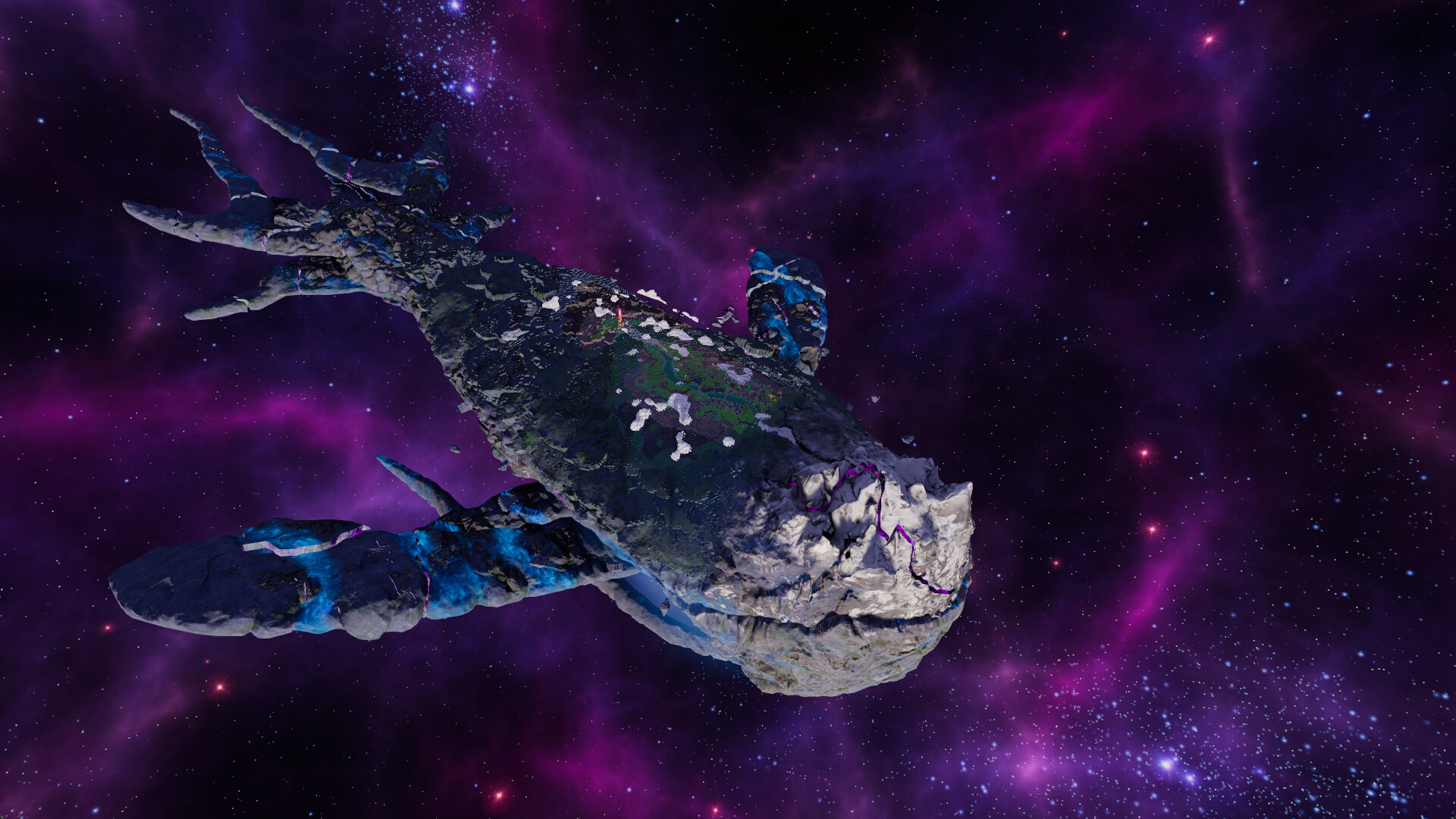
Kewa is the sentient space whale the city is built on
Kewa is the giant space whale whose back is the main map of Beyond These Stars. The official wiki describes a symbiosis: Peeps rely on Kewa for safety, water, and fertile ground, and the settlement’s care of the biome is what Kewa receives in return. Kewa also chooses how to travel, and can ignore a travel request in order to eat.
Advertisement
Where Kewa comes from
The official Peeps and Kewa articles tell the same backstory from two sides. Peeps spent ages underground on a distant planet, sheltering from destructive space whales. After they returned to the surface and rebuilt, they tried to pacify the whales. A settlement built a Whale Charmer, and a whale answered. Volunteers left in the Home Spaceship and landed on Kewa.
Kewa’s own article says the whale had lived for a very long time by eating and traveling alone. Kewa responds well to the Peeps’ arrival, likes communicating with them, and likes the improvements they make. The store text calls Kewa lonely and says the whale has hopes for the journey rather than behaving as a pet.
The developer press kit frames the player’s choice as exploitation versus living with Kewa, and says that trying to force a destination has consequences. It does not define a named “force” stat. The wiki’s concrete tool for asking is the Strange Transmitter, described below.
Biome, fertility, and air
The biome article treats Kewa’s health as a count of fertile tiles, flooded tiles, and forests that actually contribute atmosphere. A healthy biome, in that article’s summary, is mostly fertile or flooded, with enough forest that playable tiles sit inside the atmosphere.
Each tile can combine three pairs of conditions: watered or dry, dirt or bare, and breathable or not. A tile that is both watered and dirt becomes fertile on its own. “Fertile and breathable” is the condition the wiki names for forests, homes, and growing resources. More fertile ground raises Kewa’s health and happiness, and it gives agriculture more room.
Atmosphere comes from watered forests. The wiki states that one forest generates atmosphere four tiles away. The fastest expansion method it describes is digging channels so water reaches dead forest and revives it. The second method is planting new forest at the edge of the habitable zone. Both are terraforming jobs.
When the galaxy view is open, the same article says the top row shows Kewa’s health, happiness, and energy, with temperature at the bottom left. An overlay distinguishes fertile ground, unwatered dirt, and bare ground.
Terraforming tools
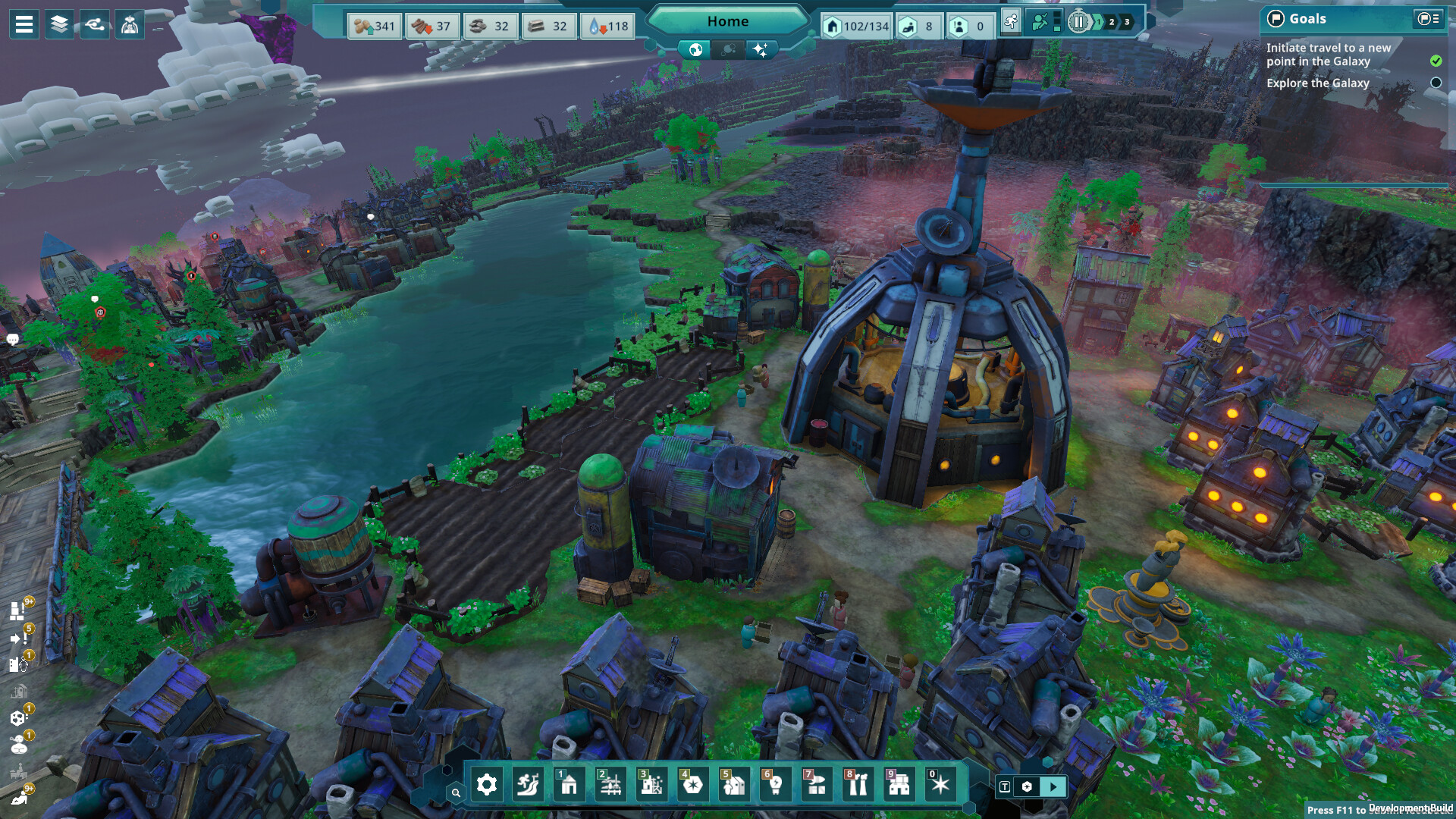
The terraforming article names three jobs: change the ground, compost it, and plant forest. It calls terraforming crusted debris a core requirement of growing the main settlement.
Landscaper
The Landscaper is the first terraforming building in that article. Workers dig or stack ground. Digging creates Debris, which has to be stored or used to build hills. The building can hold Debris for several projects, and digging stops when that storage is full. Jobs can be batched: set a height, then add more tiles to the same job.
Water channels are a special case. Digging next to flooded tiles raises a barrier that holds the water back. Finishing the job releases the water. The wiki recommends batching the channel so the depth and the release apply to the whole ditch.
Compost
The Compost Heap supplies Compost to Landscaper workers. Composting turns bare tiles into fertile ground for agriculture or forest. The article says compost is slow and costly, and that a steady supply of Wood Waste is the only early way to make it. That supply also creates other resources that are harder to store. Underwater tiles cannot be composted. Lily pads, cattails, and grasses are not replaced if that tile is later raised or lowered.
Forest
The Tree Nursery supplies Saplings. Planting them grows forest, which the article says suppresses pollution and extends the breathable atmosphere. Forest jobs batch the same way as landscaping jobs. On the buildings list, the Landscaper’s tech prerequisite is the Metal Smelter, the Compost Heap requires the Landscaper, and the Tree Nursery requires the Compost Heap. Terraforming is not presented as a first-hour tool.
Early adjacency notes on the buildings page include two that touch this work: a Water Pump gains 30 percent storage on an outcropping surrounded by three water tiles, and a Woodcutter gains 30 percent storage when forest surrounds it except for the road.
Travel and disagreement
The Kewa article says the whale can cross great distances in minutes, enjoys the cold of space, and eats asteroid belts and debris fields. Destination choice follows what Kewa needs. Peeps use the Strange Transmitter to request a nearby star or another object Kewa has already mentioned. Kewa may go there, or may detour first to find food.
The galaxy article adds the energy rule: travel spends energy, longer trips spend more, and eating restores it. If they can, Kewa passes through debris-field nodes to eat, and can also eat asteroids at asteroid-belt nodes. The quote at the top of the Kewa article is direct: the settlement affects the companion’s wellbeing, and Kewa will go against the Peeps’ wishes in order to take care of themself.
The buildings list puts the Strange Transmitter’s tech prerequisite at the Electronics Plant, and the Electronics Plant’s prerequisite at the Ore Smelter. Asking for a route is a researched action, not a starting button. How goods move before anyone leaves the whale is covered in supply chains. What the map shows after departure is covered in the galaxy guide.
What reviews add
GameObserver, reviewing a pre-release code on 13 October 2026, adds consequences the wiki pages above do not spell out. That review says pollution and toxic waste harm Kewa’s happiness, and that a very unhappy or uncomfortable Kewa can teleport without the player’s input. In that account, the jump brings asteroids that destroy buildings and extreme temperatures that damage crops. The same review says terraforming is the main way to raise happiness and to help return Kewa’s memories, including expanding waterways, composting fertile land, and planting forests, and that this also increases oxygen and habitable land.
Those memory, teleport, asteroid, and crop claims are the reviewer’s report about the version they played. They are not restated as mechanics on the official Kewa, biome, or terraforming pages fetched for this guide. LadiesGamers separately says the campaign eventually lets you speak with Kewa and travel, and that Kewa’s happiness becomes another system to watch. Neither review is a patch log, and no day-one patch notes were used here.
What is still unknown
The official pages used here do not publish a numeric formula for Kewa’s happiness, a list of foods Kewa prefers, or the exact penalty for “using too much force.” GameObserver’s memory-loss and uncommanded-teleport details are not copied into this guide as confirmed release rules. Controller support, and whether conversation freezes reported in that review were fixed, are also unknown.